

BELIEVE
I Believe in Jesus Christ, His Only Son, Our Lord
John 1
Prologue: Christ, the Eternal Word
1 In the beginning the Word already existed.
The Word was with God,
and the Word was God.
2 He existed in the beginning with God.
3 God created everything through him,
and nothing was created except through him.
4 The Word gave life to everything that was created,
and his life brought light to everyone.
5 The light shines in the darkness,
and the darkness can never extinguish it.
6 God sent a man, John the Baptist, 7 to tell about the light so that everyone might believe because of his testimony. 8 John himself was not the light; he was simply a witness to tell about the light. 9 The one who is the true light, who gives light to everyone, was coming into the world.
10 He came into the very world he created, but the world didn’t recognize him. 11 He came to his own people, and even they rejected him. 12 But to all who believed him and accepted him, he gave the right to become children of God. 13 They are reborn—not with a physical birth resulting from human passion or plan, but a birth that comes from God.
14 So the Word became human and made his home among us. He was full of unfailing love and faithfulness. And we have seen his glory, the glory of the Father’s one and only Son.
15 John testified about him when he shouted to the crowds, “This is the one I was talking about when I said, ‘Someone is coming after me who is far greater than I am, for he existed long before me.’”
16 From his abundance we have all received one gracious blessing after another. 17 For the law was given through Moses, but God’s unfailing love and faithfulness came through Jesus Christ. 18 No one has ever seen God. But the unique One, who is himself God, is near to the Father’s heart. He has revealed God to us.
Isaiah 55
11 so shall my word be that goes out from my mouth;
it shall not return to me empty,
but it shall accomplish that which I purpose
and succeed in the thing for which I sent it.
12 For you shall go out in joy
and be led back in peace;
the mountains and the hills before you
shall burst into song,
and all the trees of the field shall clap their hands.
13 Instead of the thorn shall come up the cypress;
instead of the brier shall come up the myrtle,
and it shall be to the LORD for a memorial,
for an everlasting sign that shall not be cut off.
In the Beginning
John 1:1–5 • Genesis 1:1–3
- Jesus is the eternal Word.
- Through Him all things were made.
- The Creator entered creation.
Imago Dei
John 1:9–13 • Genesis 1:26–27 • Colossians 1:15
- We were created in God's image
- Jesus is the perfect image of the Father
- In Christ, God restores Imago Dei... in us
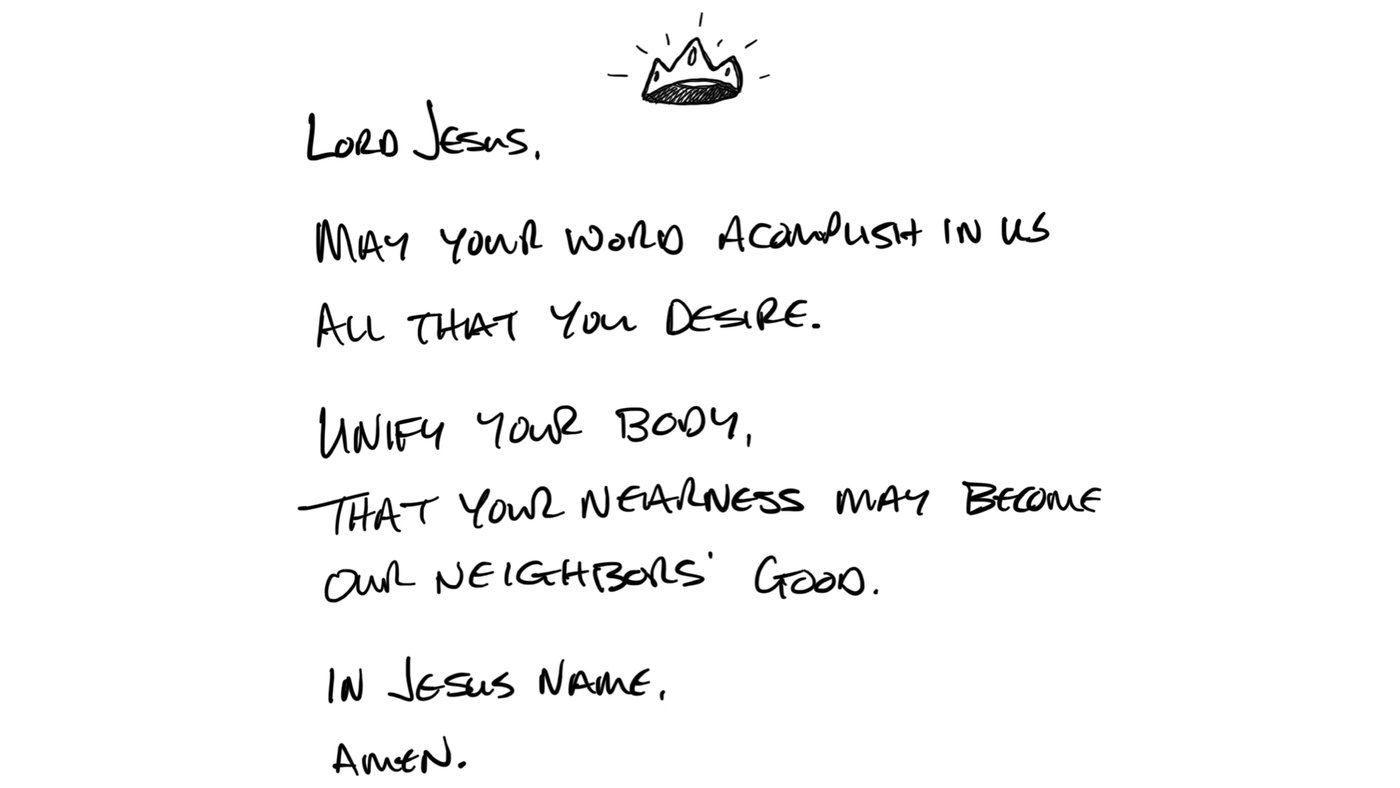
Not Return Void
Isaiah 55:10–11 • John 1:14
- God's Word always accomplishes what it is sent out to do
- Jesus = Living Word
- God's love never fails to complete its work
Jesus is Lord
John 1:1, 18 • John 20:28 • Philippians 2:5–11
- Our highest allegiance belongs to Jesus
- There is wonder working power in others-centered self-sacrificing love
- God is like Jesus
Corpus Christi
John 1:12–13 •1 Corinthians 12:12–27 • Romans 12:4–5
- Christ unites the church
- Together we embody the presence
- God's nearness becomes our neighbors' good
The Apostles' Creed
I believe in God,
the Father Almighty,
Maker of heaven and earth.
And in Jesus Christ,
his only Son, our Lord,
who was conceived by the Holy Spirit,
born of the Virgin Mary,
suffered under Pontius Pilate,
was crucified, dead, and buried.
He descended into hell.
On the third day He rose again from the dead...
WHOOOOOOO!!!
He ascended into heaven
and sits at the right hand of God the Father Almighty.
From there He will come to judge the living and the dead.
I believe in the Holy Spirit,
the holy Christian Church,
the communion of saints,
the forgiveness of sins,
the resurrection of the body,
and the life everlasting.
Amen.
Questions to Consider:
- What does Jesus reveal about the character of God?
- Where do you see God's image in yourself and others?
- What does it mean for Jesus to be Lord of your life?
- How is Christ forming you into His Body?
- How can God's nearness to you become someone else's good this week?